Stacking that measures, rather than guesses.
Nebula Stacker treats a night of subs as one inverse problem — noise model, skyglow, masking, registration and coaddition solved together — and tells you what it decided and why.
macOS and Windows · free to try, subscription to stack
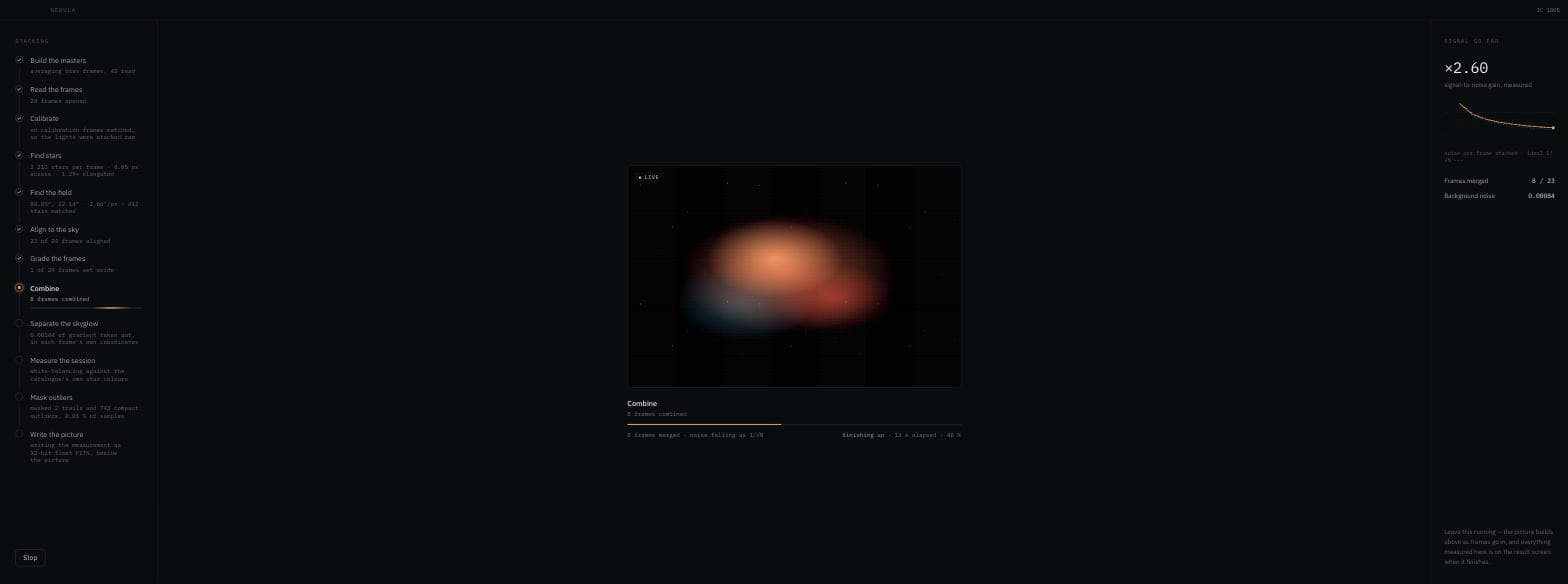
Every stage says what it measured while it runs — not a spinner and a percentage.
What it actually does
Every claim here is something the program measures on your own frames and reports back.
Your flat frames are optional
The flat field is measured from the lights themselves — same optics, same dust, same moment — using the registration to know where the target is rather than guessing statistically. A stack with no flat frames comes out no worse than one with them.
Full sensor resolution
A superpixel demosaic throws away half your resolution before the first frame lands. Nebula Stacker stacks the mosaic itself and demosaics once, at the end — a quarter tighter stars and eighty per cent more of them resolved, on the same data.
Satellites removed as objects
Not sigma clipping. A trail is found as a line, a cosmic ray as a blob, and the whole feature is masked — so you lose the satellite rather than a mottled scattering of pixels across every frame.
Trailed subs still count
A trailed frame is sharp across the trail and smeared along it. Nebula Stacker fits each frame an elliptical PSF and deconvolves in the direction the smear actually runs, so a marginal night still contributes what it has.
Colour from a catalogue
White balance measured against Gaia's own star colours, so a solar-colour star renders neutral — an absolute reference rather than whatever looked right.
It tells you what it refused
When a correction cannot be measured safely on your data, it declines and says so, with the number. A module that quietly returns nothing is a bug this project has found three times and now designs against.
Import straight from an ASIAIR
Finds the device on your network, reads a night off it — lights and calibration — and hands the folder to the pipeline. Gain is read from the file name, where the ASIAIR actually writes it.
Works with no network
The licence is verified on your machine against a key built into the app. Nothing phones home to start a stack. A subscriber on a mountain in February is not told to go online.
And then it shows its working
The result screen is a measurement, not a verdict: what the noise actually did against the frame count, where the field was on the sky, and a wipe between one sub and the stack so you can see the difference rather than be told about it.
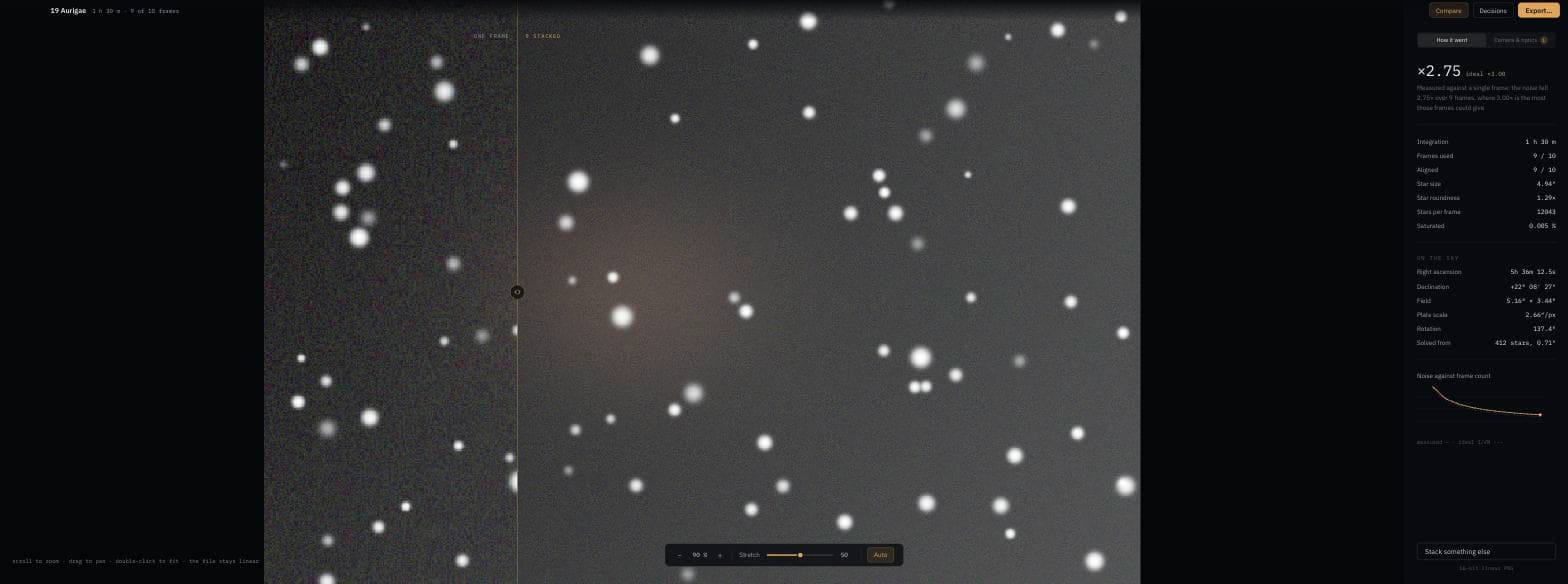
Every decision the pipeline took is listed, with the number it took it on.
Every algorithm, written down
Eight phases, from the photon transfer curve to the colour calibration — what each one does, and why it is done that way rather than the obvious way. Including the ones that look at your data and decline.
Read the pipelineTry it before you pay
Scanning, the frame browser, the plate solve and the viewer are all open. The subscription is for stacking. You can look at every frame of your own night, and see what Nebula Stacker makes of it, before deciding.